




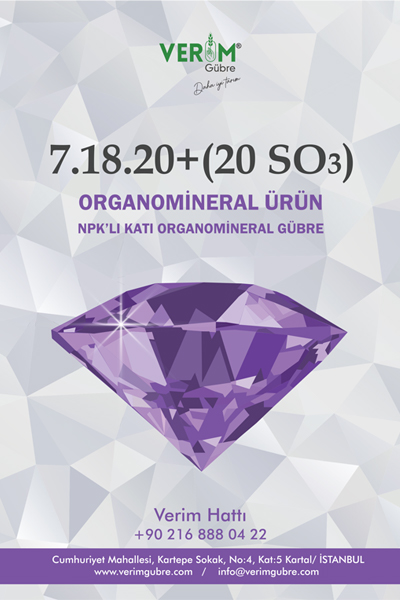
7.18.20+(20 SO3)
Plants
With its rich content, this economical product can be used as a quality-enhancing fertilizer.
In particular, if it is used in the production of sugar beet, while it increases the product, yield, sugar rate and quality of sugar beet, it also ensures the water intake balance of the plants, and helps to increase the quality parameters of the product. It is appropriate for use in vineyards and olive groves, hard-shelled fruit trees such as hazelnut-pistachio.
RECOMMENDATIONS FOR APPLICATION
Although it varies according to the purpose and place of use, the product increases the water retention in the root zone of the plant, in other words, the area where the soil comes into contact with the roots of the plant (rhizosphere zone), as well as the sandy and local soils with low-water holding capacity, and helps the aeration of the clayey soils that have low aeration by opening the between of the clay packs. With the organic acids, amino acids, and enzymes in its structure, it prevents the nutrients in the fertilizers from being leached deep into the soil through excessive rainfall and irrigation, as well it makes the nutri- ents that cannot be taken by the plants in the soil useful, and ensures that they are taken by the plants. In this way, it ensures the plants to take almost all of the fertilizer adminis- tered. In fruit trees, greenhouse and outdoor vege- table cultivation; it is also applied to the root zones of the plants in the form of tape or strip and it is mixed with the soil.
Features of Product
As active substance, it contains 7% Nitrogen (N), 18% Phosphorus (P2O5), 20% Potassium (P2O5), 20% Sulphur (SO3), and additionally 15% Organic Matter (OM).
With its nitrogen, phosphorus, potassium, or- ganic matter, and sulphur content, it contains nutrients required by the plants. It increases the water and air retention capacity of the soil, increases the germination and fringe root development rate of the seed. In particu- lar, when it is used in the pro- duction of the sugar beet, it increases the product yield and quality of sugar beet. It is beneficial for seed germina- tion following seeding and ensures a homogeneous seeding. It completely meets the nutrients required by the plant during its development period, by this means ensures optimum growth.
|
(%W/W) | |
| Organic Matter | 15 | |
| Nitrogen (N) in Total | 7 | |
| Ammonium Nitrogen (N) | 7 | |
| Phosphorus Pentaoxide (P2O5) in Total | 18 | |
| Water-Soluble Phosphorus Pentaoxide (P2O5) | 16 | |
| Water-Soluble Potassium Oxide (K2O) | 20 | |
| Sulphur Oxide (SO3) in Total | 20 | |
| Maximum Humidity | 20 | |
| Maximum Chlorine (Cl) | 10 | |
| pH | 4-6 |
| Plant |
|
Application Periods | ||
| Wheat, Barley, | 30 – 40 kg/da | Pre-Seeding | ||
| Corn, Cotton | 40 – 50 kg/da | Pre-Seeding | ||
| Paddy Sugar Beet, Onion, Peanut | 40 – 50 kg/da | Pre-Seeding | ||
| Watermelon, Melon, Carrot, Turnip, Strawberry | 40 – 50 kg/da | Pre-Seeding | ||
| Potato | 50 – 60 kg/da | Pre-Seeding | ||
| In Open Land Vegetables | 40 – 50 kg/da | Pre-Seeding | ||
| In Greenhouses | 40 – 50 kg/da | Pre-Seeding | ||
| Stone and Pome Fruit Trees (According to the age) | 1 – 4 kg/tree | Pre-Awakening of Tree | ||
| Citrus (According to the age) | 1 – 4 kg/tree | Early-Spring | ||
| Olive (According to the age) | 1 – 4 kg/tree | Early-Spring | ||
| Apple (According to the age) | 1 – 4 kg/tree | Early-Spring | ||
| Grape (Vineyard) | 40 – 50 kg/da | Early-Spring | ||
| Banana | 60 – 70 kg/da | Early-Spring | ||
| Hazelnut | 1 – 4 kg/omca | Early-Spring | ||
| Tea | 40 – 50 kg/da | Early-Spring |
Click on Image for Catalog
Click on Image for Registration Certificate
